The Interpreter: Mirko Wiederholt on “economic cycle”
LMU researchers unpack terms of art that have gone mainstream.

LMU researchers unpack terms of art that have gone mainstream.
Some technical terms have made it into everyday discourse. In this series, LMU researchers explain what these expressions mean and give a brief account of how they entered the vernacular.
Mirko Wiederholt: “For weeks, the world has been intently following not just the military action in Iran, but also its economic consequences. To what extent are these events weakening the global economy and driving it into recession?
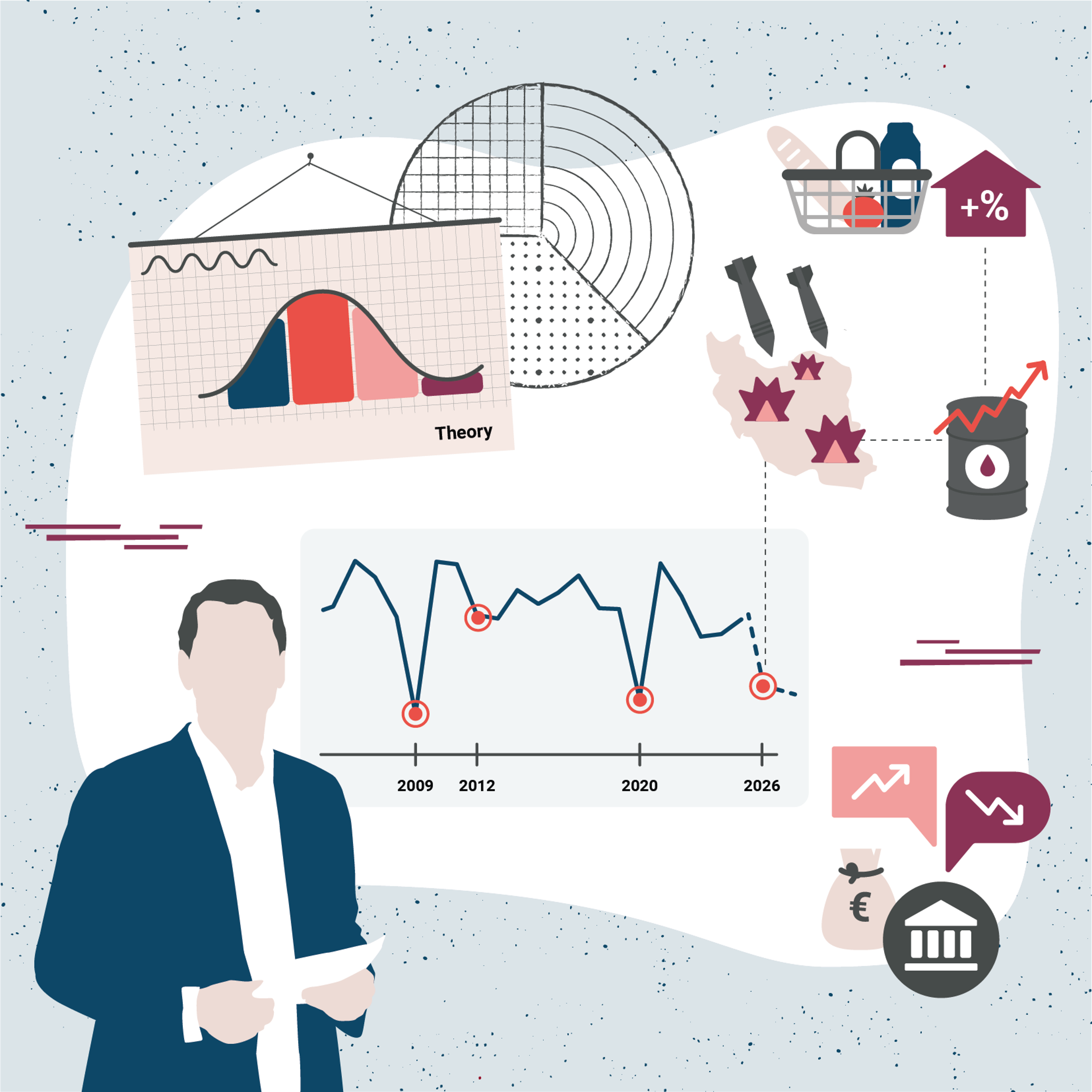
The economic cycle describes the recurring ups and downs of economic activity. Periods of rising gross domestic product (GDP) are called expansions. When GDP contracts, we speak of recession – or to be more precise, when the downturn lasts for more than two quarters. Let’s clear up a misconception right away: It was once thought that economic cycles were regular, like a sine wave. But this image is hopelessly outdated. Today we speak of shocks that hit an economy and drive GDP upward or downward at irregular intervals. Positive shocks make GDP grow, while negative ones make it shrink. If these contractions are particularly strong, or if the economy is weak like Germany’s at the moment, the economy can tip into a recession. When GDP increases again, the recession is over.

Rising fuel prices: Prof. Mirko Wiederholt at a Munich gas station
Sometimes the shocks are large, sometimes small. There are also periods when multiple shocks coincide, with overlapping effects. The years since the global financial crisis of 2007-2008 are a good example. In this relatively short period, economies have suffered a variety of shocks: the global financial crisis itself, the euro crisis, the pandemic, the war in Ukraine – and now the Iran war. This shows clearly that shock-driven economic cycles are far from regular.
The current Iran war is a classic negative supply shock. This happens when there’s an increase in the input prices that companies have to pay for things like raw materials and energy. Due to the rising costs, companies increase their prices. Households – consumers in other words – consume less, as they have less real income for the same nominal income. The strength and duration of the shock’s effects depend heavily on possible second-round effects. These arise, for example, when costs and prices drive each other up, and subsequently wages and prices do likewise, creating an upward spiral.
In response, central banks typically raise base interest rates to combat inflation. This further dampens consumption and investment. The crucial question for central banks at times like this – I’m thinking of the Iran war – is whether and when they have to increase base rates.
In challenging economic times, public attention becomes keenly attuned to signs of negative growth, to downturns in the economic cycle. Households tend to become more interested in, and better informed about, the state of the economy when things are not running smoothly, such as when the rate of inflation is climbing. We see this pattern clearly in our research. It’s a similar story later when a recession looms. This is due to the presence of the topic in the media, but also because consumers are directly noticing the effects. Yet this negative bias can obscure a more important point: although shocks repeatedly send the economy on a rollercoaster ride, stable economic growth continues in the background in the medium and long term.”
Mirko Wiederholt is Professor of Macroeconomics at LMU.
Read more articles from LMU's research magazine in the online section and never miss an issue by activating the magazine alert!